
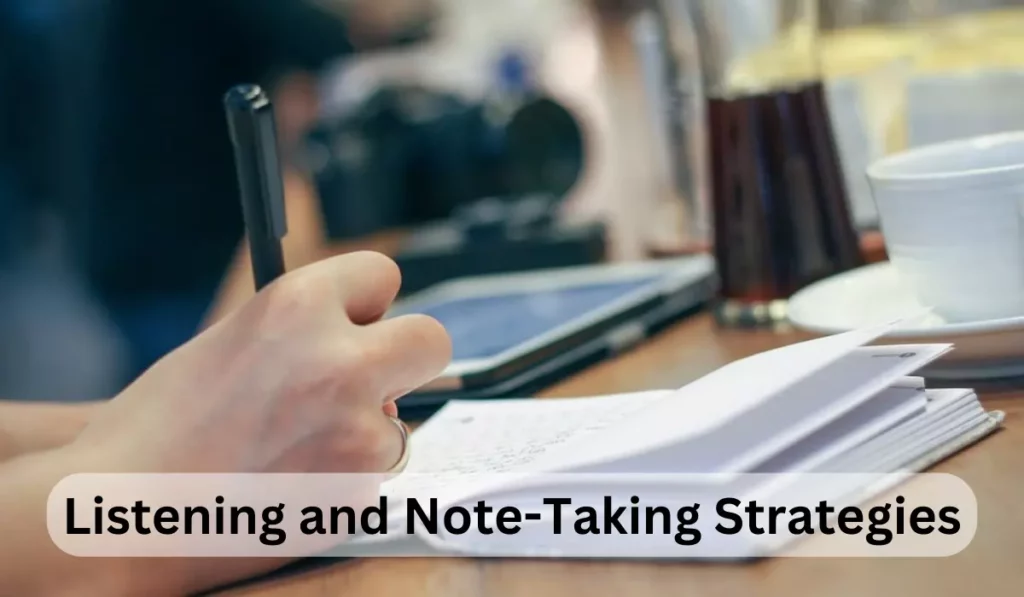

As a college student, you should learn listening and note-taking strategies for learning the material taught by the professor. While the professor is lecturing, you should listen and prepare notes for studying and understanding the lecture material after the class. Notes are vital for learning the material effectively and scoring good grades.
In this article, I will explain practical strategies for listening and note-taking effectively in class. Some of the strategies include writing techniques, symbols, diagrams, etc.
1. Prepare before the lecture.
Prepare yourself before the lecture by doing the following:
- Go through the lecture topic and familiarize yourself by checking the course outline. Read the topic material before the lectures.
- Download and read lecture slides, if possible, or download previous year’s slides if the same professor took the classes last year.
- Keep your note-taking materials like notebooks, pens, etc.
- Arrive early in the class and sit in the front for better focus.
2. Be focused and Listen.
Pay attention to what your professor is saying. Analyzing the content will help you remain focused. Sit in front to improve focus. Listen and don’t just hear. Hearing is unconscious, but listening requires paying attention actively to the lecture. You can hear something if you are not focused on it but won’t remember it effectively, but if you listen actively, you will remember it.
3. Be selective and note down the main points.
Be selective about what you are noting down. Don’t write everything that your professor said. Note down main points, examples, and concepts. Use hints from the professor to recognize important points. Hints could be verbal, like “this is important” or “to sum up,” a concluding remarks, etc.
Acquainting oneself with effective tips for using college library resources can significantly enhance the quality of research and study, offering access to diverse materials and specialized assistance for academic success.
4. Use writing techniques for faster note-taking.
Use the following tips for faster note-taking:
- Use phrases and keywords instead of complete sentences.
- Rewrite the explanations in your own words for better understanding and retention.
- Use symbols like “$,” “#,” or “Imp:” to differentiate important points from other points.
- Mark or highlight important sections or points to make them stand out. You can underline, circle, or point an arrow for marking and highlighting.
- Use abbreviations for certain words and concepts to avoid writing complete words. Some of the general abbreviations are “etc.,” “e.g.,” etc. You can create personal abbreviations for certain words like “gov” for government.
- Use symbols instead of certain words like equals, greater than, not equals to, etc.
5. Review the notes after the lecture.
Review the notes soon after the lecture while the lecture is still fresh in your mind. Do the following after the lecture for a better understanding of the lecture:
- Read the notes again and make sure you understand the lecture.
- Make sure the notes are clear and legible. Correct any errors like grammatical, conceptual, etc.
- Expand on the points wherever necessary. For instance, you might have missed writing down certain things and left gaps for them. Fill those gaps and complete the notes.
- Structure the notes using headings, sub-headings, bullet points, etc.
- Clarify the diagrams you drew in the lecture by labeling certain parts, adding explanations, etc.
- Highlight and mark the main points to make them stand out by underlining, circling, pointing arrows, etc.
Exploring techniques on how to improve memory for studying is key for students, as it enables better retention, recall, and application of learned material, fostering more effective study habits.
Final Words
Employing the listening and note-taking strategies discussed in this article, you will start creating better notes during lectures. You should use writing techniques and tips for faster note-taking. You can use listening techniques to engage yourself during the lecture and understand the study material. Review your notes soon after the lecture and edit them for better clarity.