
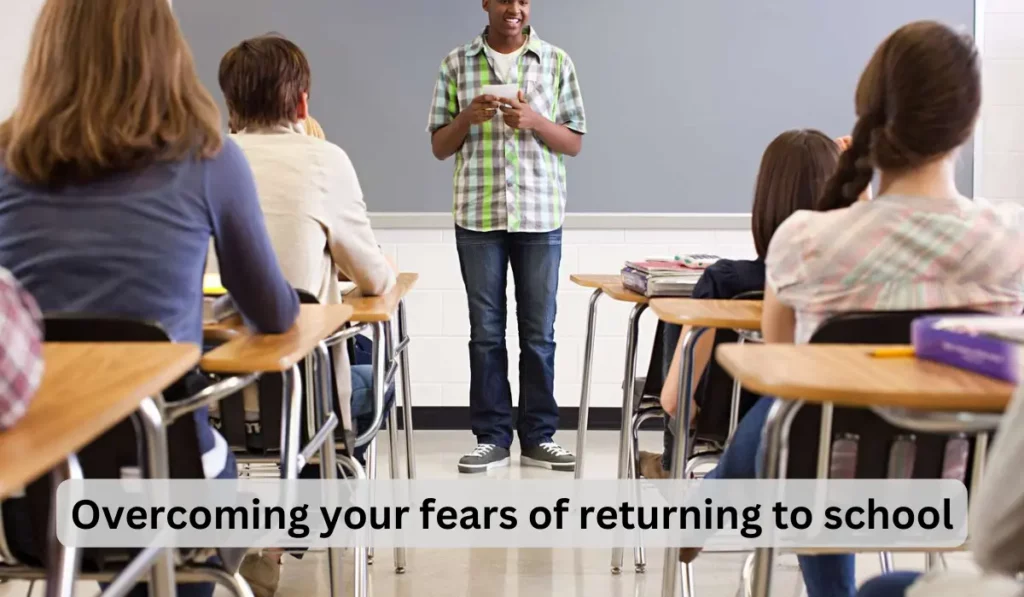

According to a study by the US Bureau of Labor in 2021, after completing high school, 38.2% of the students didn’t enroll in college. Another study conducted in 2019 shows that 44% of students didn’t get into college right after school. They enrolled in the next 4 years.
So, if you didn’t enroll in college right after school, that is entirely okay and there is nothing to be ashamed of.
You’re not the only one, there are thousands of people who decided not to go to college after school. And there are a lot of people who have completed graduation at an older age.
Being fearful of returning to college is normal, most adults who’ve returned to college after a long break dealt with it. And trust me, dealing with it isn’t as scary or difficult as it seems.
Whatever it is, if you’re fearful about returning to college, don’t miss out on this guide. Here, we’ll be showing you how to overcome your fear of going back to college as an adult.
Key Takeaways
- Embrace self-confidence by disregarding what others think; negative self-perception is often the real challenge.
- Overcome social anxiety by actively engaging with new people, gradually conquering your fears.
- Starting something new, like college, can be intimidating, but taking the first step is the hardest. Once you do, the path ahead becomes less daunting.
7 Most Common Reasons Why Adults Fear Going Back to College
There are a lot of reasons that might be holding an adult to go back to college and here are the 7 most common ones:
- Old Age: Often, adults fear being judged by younger students in college due to the age gap.
- Self-Doubt: Adults may doubt their ability to perform as well as young students.
- Financial Concern: If the person isn’t financially well-off, the tuition fee, cost of books, sheets, transportation, and other costs can make him/her worried.
- Time Management: It can be pretty challenging to balance work and family alongside college, which can cause anxiety in many adults.
- Social Anxiety: Some introverts are fearful of interacting with new people, leading to social anxiety.
- Fear of Failure: The fear of not being able to complete the course or achieve the academic goal holds a lot of adults back from returning to college.
- Change in Routine: Adults who have already established a routine and habit might be disrupted if he/she enrolls in college, some adults aren’t comfortable getting out of the set routine.
Overcoming the Fears of Going Back to the College
According to Forbes, between 2014 and 2019, 1 million college dropouts have re-enrolled in colleges. See? There are a lot of people like you who showed the courage to pick things up from where they left off. If they’re doing it, you can too.
To overcome any fear, you need a combination of mental, physical, and emotional strategies. And it’s a journey that requires courage, passion, and patience. Here, we’ll be looking into the 7 key strategies to overcome fear easily.
1. Acknowledge that You’re Afraid
Most of the people who are afraid try to fight off the fear by pretending they’re not afraid and it makes the situation worse.
Tell yourself, “Everyone is afraid of something and it’s okay for me to be afraid to go back to college.”
Accepting the fear will allow you to analyze it and understand it better, which is a crucial step in overcoming fear. Hiding it will only make you more afraid.
2. Try to Understand the Fear
Now, try to find the root cause of the fear. Is it because of the age gap? Or is it due to financial issues? Understand the fear, this will help you get rid of that pretty easily.
3. Talk with Family and Friends
The next thing you should do is talk with your family members and close friends. That being said, make sure you share the matter only with people who actually care for you.
Share your concerns with them, and share how you feel. If it’s a financial issue, consult with your family and come up with a plan, having someone holding your back will make the journey way too easy.
I know it might be a little difficult to open up to your family members, but don’t forget, they are your biggest support. If you try to cross a fearful road all alone, chances are high that you’ll give up.
They are your family and they will understand and support you no matter what. And with their support, it won’t be hard.
4. Joining a Support Group
If you look around a bit, you should come across some support groups made up of students who didn’t get into college right after school. Joining one such group can be a huge boost to your new journey.
In such groups, there will be people who are currently walking your road and there will be some who’ve already done that. People in such groups share a lot of useful resources and information which can come to your aid.
As you discuss, seek advice, open up about your anxieties, you’ll get a tremendous amount of emotional support. And you’ll start feeling that you’re not alone and you can get through much worse.
If you don’t find such groups, find some people who have gone through the same struggles and communicate. It’ll significantly help other people like you out there.
5. Imagine the Worst Scenario
Let’s say you’re afraid that young students in college will judge you because of your age. Now, for instance, let’s assume they are actually judging you for your age, what’s the worst thing that can happen?
In the beginning, you might just feel intimidated a bit, then what?
Some students are staring at you for a few days, that’s the worst-case scenario. And that too, is going to be solved in a few days because people will get used to it.
Ask yourself, is there anything that will do physical harm to me? Or anything that’ll ruin my future?
If the answer is “No,” then know that dealing with this fear is very easy.
You just need to step into the octagon, once you face it with courage, trust me, it’s going to fade away. Yes, I know that imagining the worst scenario might increase your anxiety which is a downside. But once you try, you’ll realize how easy it is to get over that fear. So it’s definitely worth the sacrifice.
6. Prepare Yourself
Equip yourself well before entering college, that’ll definitely reduce a bit of stress. Here are what you should take care of in advance to eliminate some stress:
- Know how much of tuition and other fees you’ll have to pay
- Sit & talk with your family and plan how to deal with the cost
- Make a budget plan and keep some money aside for emergencies
- Get all the necessary textbooks
- Gather the class routine
- Familiarize yourself with the offices, library, etc. on the campus
- Do some homework on the starting chapters
According to psychologist Robert Epstein, preparing in advance and planning things can significantly reduce stress.
One more thing you can do is look for someone from the same age group who has also enrolled in college. This will make the fear go away.
7. Keep a Positive Mindset
When you start thinking of doing something that’s out of your comfort zone, being clouded by negative thoughts is very natural. Everyone who’s achieved something challenging in life has gone through it and you’re no exception.
Stop thinking you are not capable of completing college, or students there won’t accept you, or you might fail, etc.
You’re what you think, so never ever think negative. Keep a positive mindset, and remind yourself that you’re not worthless.
Also, keep in mind that at the beginning, things might be a little awkward, but eventually, everything will become normal with time.
It might be hard for you to catch up with the lectures initially, but with time, you’ll catch the pace. If others are doing it, you can too.
8. Start Going to College
The most effective way to overcome fear is to face it, just search online, you’ll find top psychologists saying it.
If you’re afraid that students won’t accept you due to your age, or you won’t be able to pass the tests, or you’re not feeling like changing the routine, just get in the ring.
Sit and talk to your family, if you have their full support, enroll and start going to college. The 1st day will surely be a little awkward, but I promise you, the 10th day won’t be as awkward as the 1st day.
As time passes, you’ll start to become more comfortable. Stay attentive in the lectures, do the homework, and sit for the tests with full confidence. In the beginning, you might fail, but that’s a part of the process. You have to keep going.
If it’s hard to understand the lectures, reach out to the teacher after the class. Or you can solve your problems online, there are a bunch of ways to solve your doubts, such as YouTube videos and many tutoring apps.
9 Practical Tips for the Academic Success of Adult Learners
Returning back to college after a long break can be a little challenging. But it can be overcome pretty easily with proper guidance, planning, and discipline. Here are some practical tips you can use to do well academically—
- Always remember the goal for which you’ve returned to the college, this should keep you motivated.
- Try to pick a major that blends with your interests, this will make studying fun and easy for you.
- Make a schedule of daily study and work timings.
- Pick a quiet, clean, and comfortable study room where you can study without any disturbance.
- Take advantage of the college support services such as tutoring, library resources, academic advising, etc.
- Try your best to build a network with students, seniors, and professors.
- Group studies can help massively in understanding different topics.
- Set achievable goals and work patiently for them.
- Don’t hesitate to seek out for help when needed.
Conclusion
Well, that’s it. we’re wrapping up this guide on “how to overcome your fear of going back to college as an adult” with a few last words. Everyone struggles with something and those who have achieved something in life, sacrificed their comfort zone.
Thus, if you want to get into college and get a degree, and you’re really passionate about it, get right into it. I hope this guide helps.
References:
- Forbes : “Finishing What They Started:One Million Adults Return To College And Earn A Degree” (https://www.forbes.com/sites/michaeltnietzel/2019/10/30/finishing-what-they-started-one-million-adults-return-to-college-and-earn-a-degree/0
- U.S. Bureau of Labor Statistics : “61.8 percent of recent high school graduates enrolled in college in October 2021” (https://www.bls.gov/opub/ted/2022/61-8-percent-of-recent-high-school-graduates-enrolled-in-college-in-october-2021.htm)
- Research : “Percentage of High School Graduates That Go to College in the U.S. by State & Demographics” (https://research.com/education/percentage-of-high-school-graduates-that-go-to-college/)